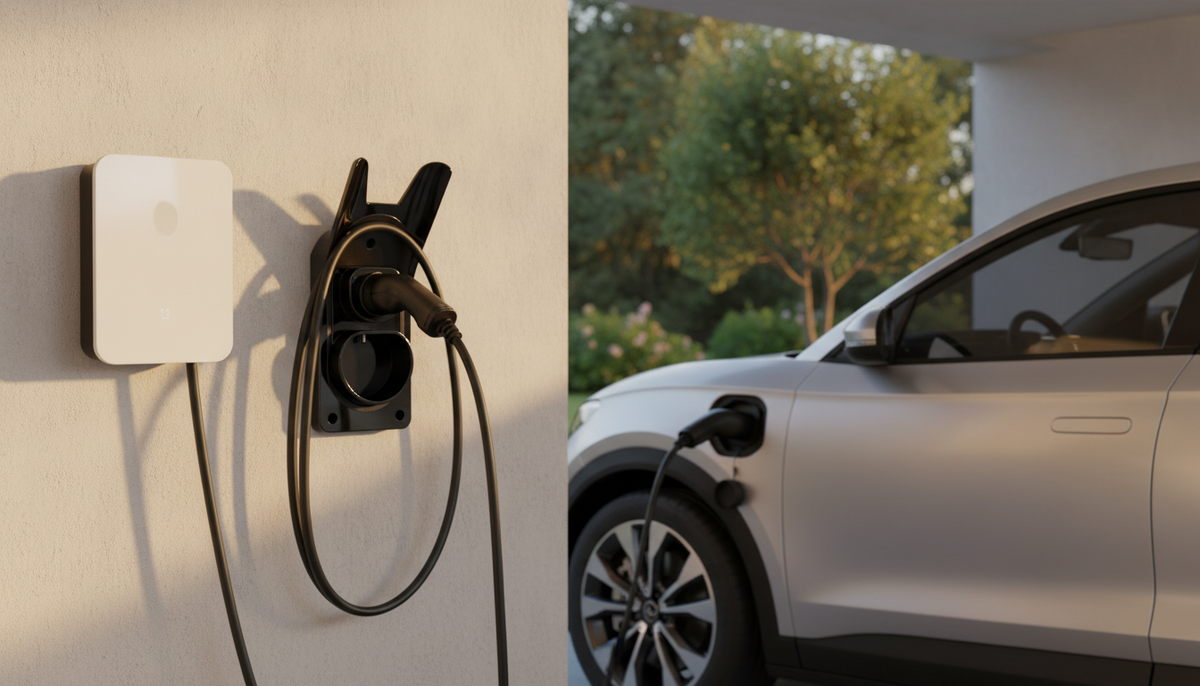
Charging from a socket often means an outdoor socket: on the house wall, under a carport, at the end of the drive. Some sockets are designed for exactly this, such as Legrand’s reinforced Green’Up socket, widely used in France, whose surface-mounted Green’Up Access version is rated IP66 and IK08. What stays exposed is the rest of the chain: the plug, the Mode 2 “granny” cable and its control box, and the Type 2 connector. These often cost more than the socket and sometimes spend the night outside. Here is how to protect the whole setup without getting in the way of charging.
- A socket designed for outdoor use is rarely the problem: the weak point is the cable left next to it.
- A canopy keeps direct rain off the plug area; it changes neither the socket’s IP rating nor the cable’s.
- Between charges, store the cable on the wall, off the ground, with the connector protected – and locked if others can reach it.
- The dedicated circuit and RCD protection are a job for an electrician: no accessory makes up for an unsuitable installation.
Outdoor socket charging: what is really exposed
| Part | What it faces outdoors | Good habit |
|---|---|---|
| The socket | Outdoor models have a hinged cover; the Green’Up Access is rated IP66 and IK08. | Close the cover when not charging and follow the manufacturer’s care instructions. |
| The plug | Water running down onto the plug area, knocks, a cable pulling downwards. | A canopy above, a cable that drops without tension. |
| The control box | It hangs from the plug, lies on the ground or sits in a puddle. | Support or rest it as the cable manual describes. |
| The cable | Run over by a wheel, worn by rubbing, dirty. | Wall storage and a route away from foot and vehicle traffic. |
| The Type 2 connector | Dirty, wet, or taken if it is within easy reach. | A dedicated holder, dry, locked if the spot is accessible. |
Protecting the plug area from rain
The stated IP rating applies to the socket itself. Once the plug is in, the socket, plug and cable work as one system: check your Mode 2 cable’s manual for its own IP rating and conditions of use in the rain. To read these codes, see our guide to IP and IK ratings.
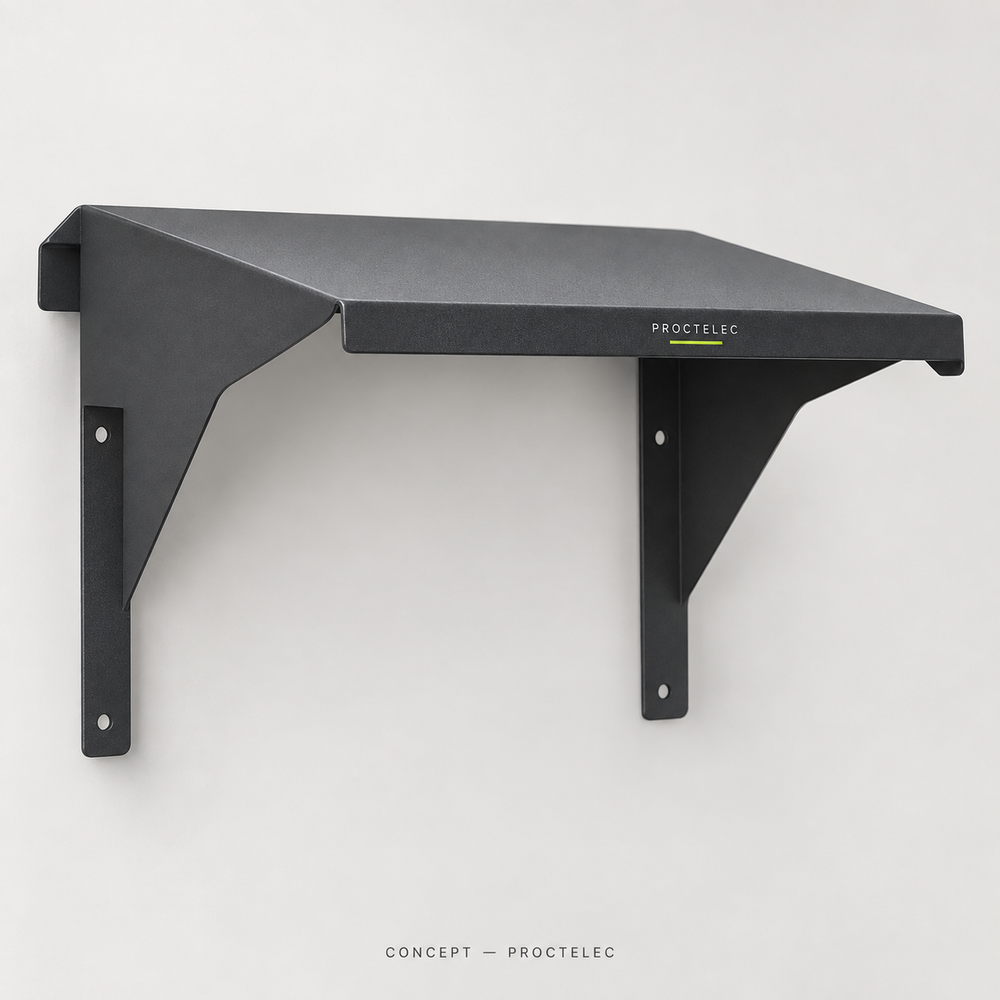
On an exposed wall with no roof overhang, a canopy covers the top of the socket and the plug. The Shelter canopy is designed for a wall charger: on a socket, check its width, mounting height and access to the hinged cover before fixing it.
Storing the Mode 2 cable between charges
A Mode 2 cable, often called a granny charger or portable charger, combines a plug for the socket, a control box and a Type 2 connector for the car. The most common mistakes: leaving it coiled on the ground, letting the box hang from the plug, forgetting the connector outside.
- Unplug in the order given in the cable and vehicle manuals.
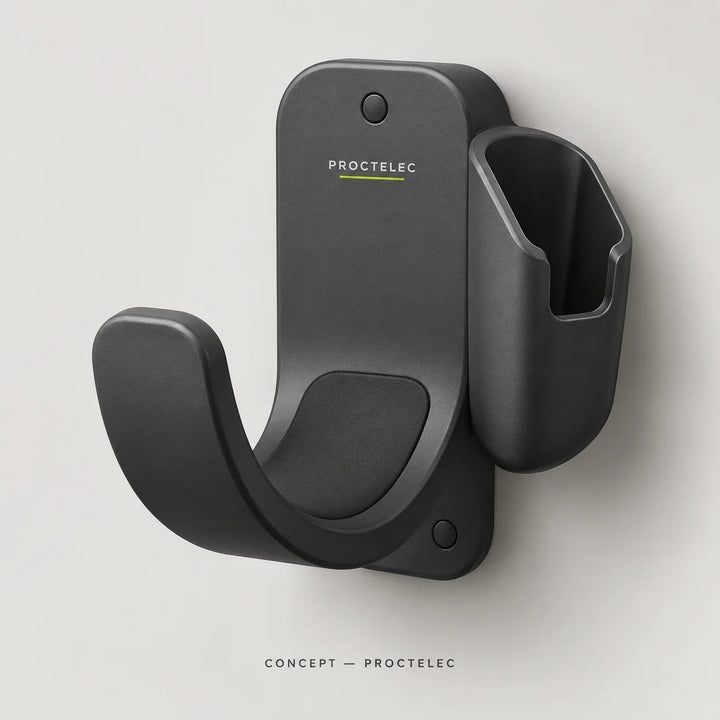
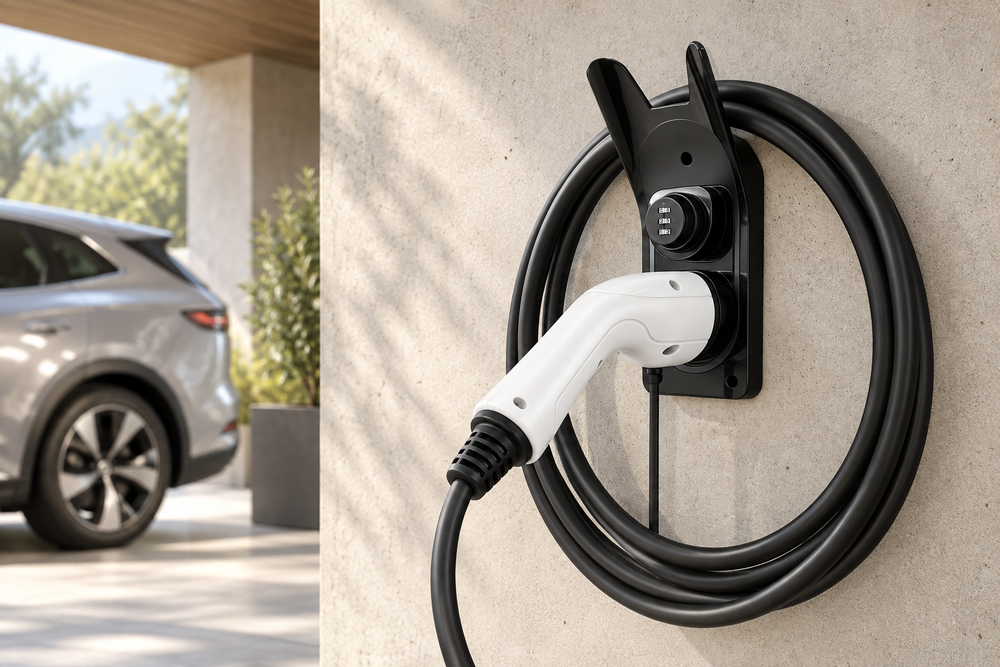
- Coil the cable in loose loops on a wall holder next to the socket, such as Loop T2.
- Give the Type 2 connector its own place, away from the ground and water, on a Dock T2.
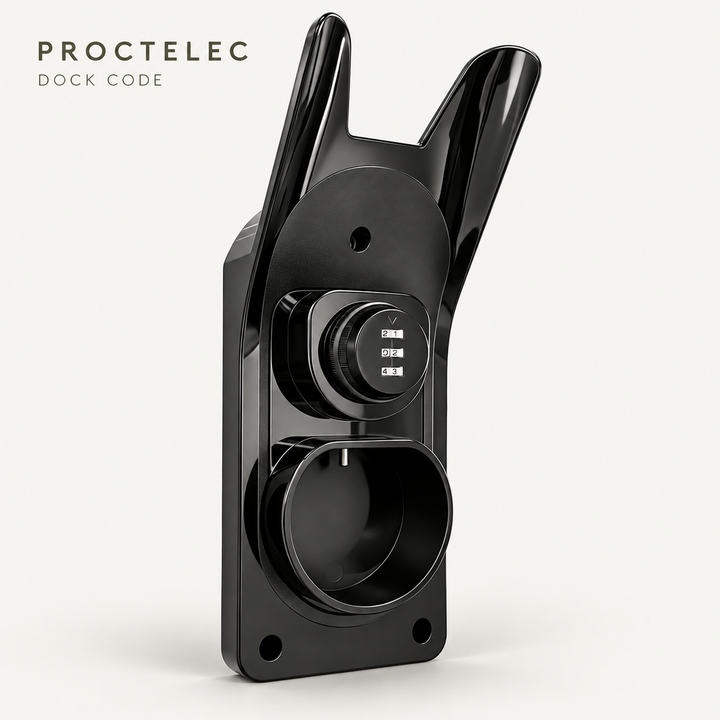
- Lock it if the socket can be seen from the street or a shared car park, with a three-digit Dock Code.
- For trips, slip the cable and box into the Carry bag. Never charge with the cable coiled in its bag.
To compare every way of storing a cable, read EV charging cable storage: 7 solutions. Charging a Tesla with the Mobile Connector? See our Tesla charging accessories.
Cable theft: the weak spot of an outdoor socket
While charging, many vehicles lock the connector on the car side, so taking the cable means cutting it. The risk shifts to the time between charges, when the cable stays by the socket: it can be unplugged in seconds. Three simple answers: bring it in, lock it under a code, or limit access to the space.
- Dock Code holds the Type 2 handle on the wall behind a code.
- The Park barrier keeps a private space free and other vehicles away from the socket.
- If it happens, see EV charging cable stolen? What to do next.
Installation: a job for the electrician
A standard household socket is not automatically suited to the long continuous load of charging an EV. Have the socket, circuit and RCD protection checked by a qualified electrician, or install a dedicated charging socket. For reference, Legrand states a maximum of 3.7 kW for its ready-to-fit Green’Up kit; a distributor’s data sheet specifies a dedicated 3 × 2.5 mm² circuit protected by a 30 mA RCBO. Our guide to EV charger electrical protection helps you prepare that conversation.
One rule applies to every socket: no extension lead or multi-socket adapter between the socket and the charging cable, unless the manuals explicitly allow it.
Frequently asked questions
Can I charge my EV from an outdoor socket?
Yes, if the socket and circuit are suitable and the cable allows it. Have the installation checked by an electrician; reinforced models such as the Green’Up Access are explicitly rated for outdoor use.
Can I charge from an outdoor socket in the rain?
Check the socket’s rating and your Mode 2 cable’s manual. A canopy keeps direct rain off the plug area. Never use a damaged socket, plug or cable.
Should I enclose the socket in a box?
The socket has its own cover. Enclosing a socket under load in a closed box raises questions of heat, ventilation and access: ask your electrician. A canopy, by contrast, stays open.
Can I leave the granny cable plugged in outside permanently?
It is better to store it between charges: it is less exposed to water, UV, knocks and theft. Follow the cable manufacturer’s instructions.
What is the difference between a granny cable and a wall charger?
A granny cable is a Mode 2 cable with a control box for a socket. A wall charger has that control built in and usually delivers more power. For sizes of common models, see our EV charger size chart.
Equip your outdoor socket
A wall holder for the cable, a place for the connector, a code if the spot is accessible: often that is all an outdoor charging socket is missing.
See the Dock Code lock holder →
Compare: cable holders and bags · canopies and covers.