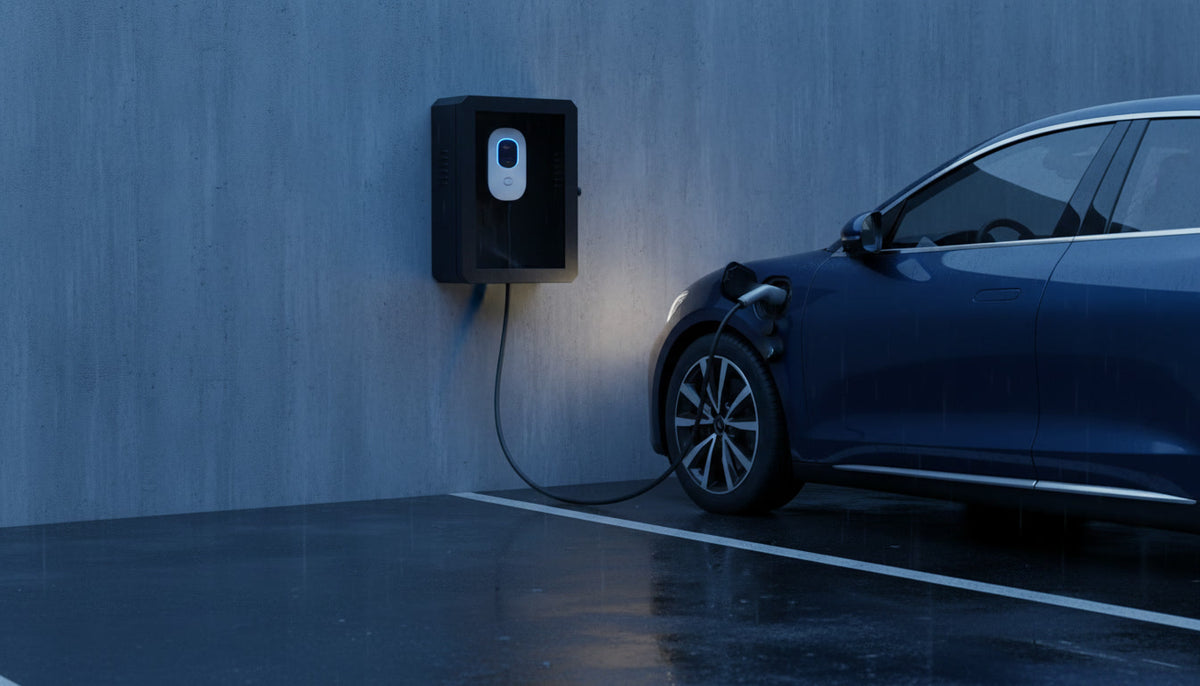
EV charger electrical protection rests on three pillars: a dedicated circuit, a circuit breaker sized for the charger and a 30 mA RCD suited to the leakage currents specific to electric vehicles. Depending on the installation, a surge protector may be added. This guide helps you understand these choices and prepare for the conversation with a qualified EV-charging electrician (IRVE-certified in France), who alone can decide on the right solution for your consumer unit.
- In France, a charger rated above 3.7 kW must be installed by a professional holding an IRVE qualification. Elsewhere, follow local regulations and use a qualified electrician.
- Each charging point has its own circuit, its own circuit breaker and its own 30 mA RCD.
- A type A (or F) RCD only if 6 mA DC leakage detection is built into the charger or added to the circuit; otherwise, type B.
- A surge protector is not always required: it depends on the configuration, and it is up to the electrician to decide.
- Proctelec sells physical protection accessories, not electrical switchgear.
IRVE installation in France: who must install your EV charger?
In France, Decree No. 2017-26 of 12 January 2017 set the rule: charging infrastructure rated above 3.7 kW must be installed by a qualified professional. This obligation now appears in Article D. 353-2 of the French Energy Code (Code de l’énergie), introduced by Decree No. 2024-649 of 30 June 2024, which governs the accreditation of the bodies that issue these qualifications.
In practice, almost every wallbox is affected: a 7.4 kW single-phase charger, or an 11 kW or 22 kW three-phase charger, exceeds this threshold. An installation of 3.7 kW or less in a private home, such as a reinforced socket, is not subject to this qualification requirement, but it must comply with the French wiring standard NF C 15-100: have it done by an electrician. Installation grants such as the French Advenir programme also require a qualified installer. Outside France, the rules vary from country to country: follow your local regulations and have your charger installed by a qualified electrician.
There are several qualification levels depending on the complexity of the project, often referred to as P1, P2 and P3. Ask your contractor which level matches your project and for a copy of their certificate.
Dedicated circuit and EV charger circuit breaker
Section 7-722 of the French standard NF C 15-100, which transposes the international standard IEC 60364-7-722, requires a dedicated circuit for each charging point. No other socket or appliance may be connected to it. Two chargers therefore mean two separate circuits.
The EV charger circuit breaker protects this circuit against overloads and short circuits. Its rating depends on the charger’s maximum current, the cross-section of the supply cable, its length and how it is installed. As a rough guide, a 7.4 kW single-phase charger runs at around 32 A, an 11 kW three-phase charger at around 16 A per phase and a 22 kW three-phase charger at around 32 A per phase. The final choice is up to the electrician, who can also limit the charging current in the charger’s settings.
Also consider the power available under your electricity contract. A 7.4 kW charger on a modest supply contract can cause the power to cut out when the oven, heating and charging run at the same time. Depending on the situation, the electrician may suggest limiting the charger’s output, installing load shedding or dynamic load management, or upgrading your contract.
EV charger RCD: type A or type B?
Each charging point must be protected by its own 30 mA residual current device (RCD). The choice of RCD type comes down to a particular feature of electric vehicles: in the event of a fault, their on-board charger can produce a DC leakage current. Above a few milliamps, this DC current can “blind” a type A or AC RCD, which may then fail to trip correctly.
The French standard therefore accepts two solutions: a type B RCD, which also detects smooth DC currents, or a type A or F RCD combined with a 6 mA DC detection device (often called an RDC-DD, compliant with IEC 62955). Many wallboxes include this detection: the data sheet then mentions it as “6 mA DC detection”, “RDC-DD” or “IEC 62955”. Check your model’s manual or ask your electrician.
| Type | Faults detected | For a charging point |
|---|---|---|
| AC | Sinusoidal AC fault currents. | Not suitable. |
| A | AC and pulsating DC. | Only with 6 mA DC leakage detection, built into the charger or added to the circuit. |
| F | As type A, with better immunity to nuisance tripping. | Same condition as type A; often recommended for its stability. |
| B | AC, pulsating DC and smooth DC. | Suitable without an additional 6 mA detection module; a more expensive device. |
Two mistakes come up often: sharing one RCD between two chargers, and replacing a type B with a type A without checking that the charger detects DC leakage.
Surge protector for an EV charger: when is it needed?
A surge protector (SPD) protects the installation against transient overvoltages, for example when lightning strikes near the grid. For an EV charger, it is not systematically required. In France, it may be mandatory depending on the configuration: a building fitted with a lightning rod, a supply via an overhead line in an area with high thunderstorm activity, or a publicly accessible charging point. In other cases, it remains a considered choice based on the site’s exposure and the value of the equipment.
The revised version of NF C 15-100 also sets rules for equipment located far from the main surge protector in the consumer unit. If your charger sits at the end of a driveway or in a detached garage, ask your electrician whether additional protection is planned: this decision depends on an analysis specific to your installation.
IP and IK ratings: the charger’s enclosure
In France, section 7-722 sets minimum levels depending on the location, notably protection against splashing water outdoors and increased impact resistance in publicly accessible places. In practice, an IP54 rating is commonly recommended for an outdoor charger, IP55 to IP65 for a very exposed location, and IK08 to IK10 ratings are sought in car parks.
These ratings belong to the charger and are declared by its manufacturer. A canopy, cover or enclosure does not change them. The IP54, IP55, IP65, IK08 and IK10 codes are explained in detail in our guide to EV charger IP and IK ratings. To choose the location and protection for a charger installed outdoors, see our guide on how to protect an outdoor EV charger.
Checklist before installing your EV charger
- Target power (3.7, 7.4, 11 or 22 kW) and single-phase or three-phase connection.
- Power available under your electricity contract and any need for load shedding or load management.
- In France, an installer holding an IRVE qualification if the charger exceeds 3.7 kW: ask for their certificate. Elsewhere, a qualified electrician working to local regulations.
- Dedicated circuit from the consumer unit and a circuit breaker sized for the charger and the cable.
- Dedicated 30 mA RCD: type A or F with confirmed 6 mA DC detection, or type B.
- Need for a surge protector assessed and justified by the electrician.
- Location: suitable IP and IK ratings, exposure to sun and rain, distance to the vehicle’s charging port.
- Route of the supply cable and vehicle traffic areas.
- In a shared residential building, get approval from the building management before any installation in common areas.
- Documents to keep: wiring diagram, protection device specifications, manual and invoice.
- Planned physical protection: shelter, cable storage, controlled access to the charger housing.
Physical protection complements electrical protection
Circuit breakers, RCDs and surge protectors protect people and the installation against electrical faults. They do nothing against cable theft, a knock from a bumper, rain running down the housing or vandalism. That second aspect is what Proctelec covers. We sell mechanical accessories, not electrical equipment, and we do not carry out work on installations.
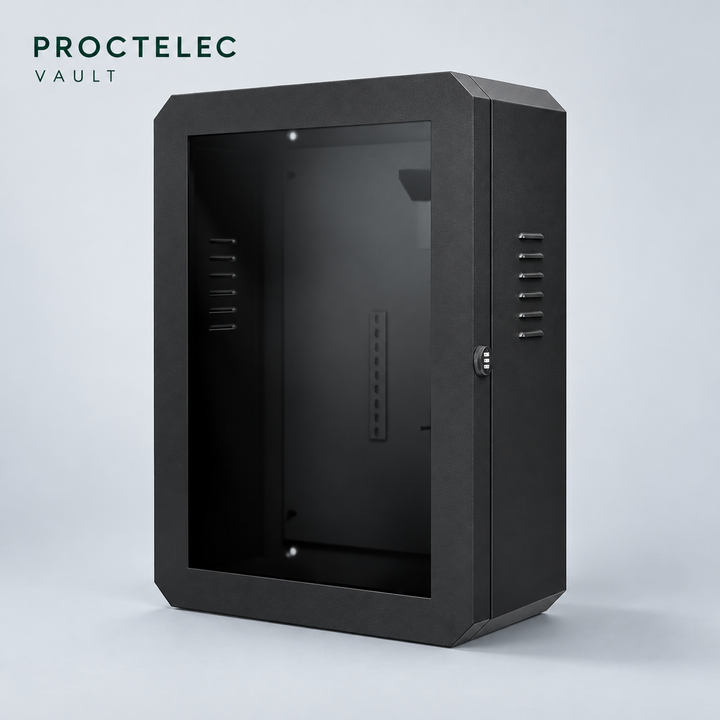
- Access to the housing: the Vault enclosure, made of steel with a transparent door and a combination lock, comes in 60 × 40 × 20 cm (€199.90) and 70 × 50 × 25 cm (€249.90). Have your electrician approve ventilation and clearances.
- Rain and snow: the Shelter canopy (€44.90) covers the top of a wall-mounted wallbox. It does not change the charger’s IP rating.
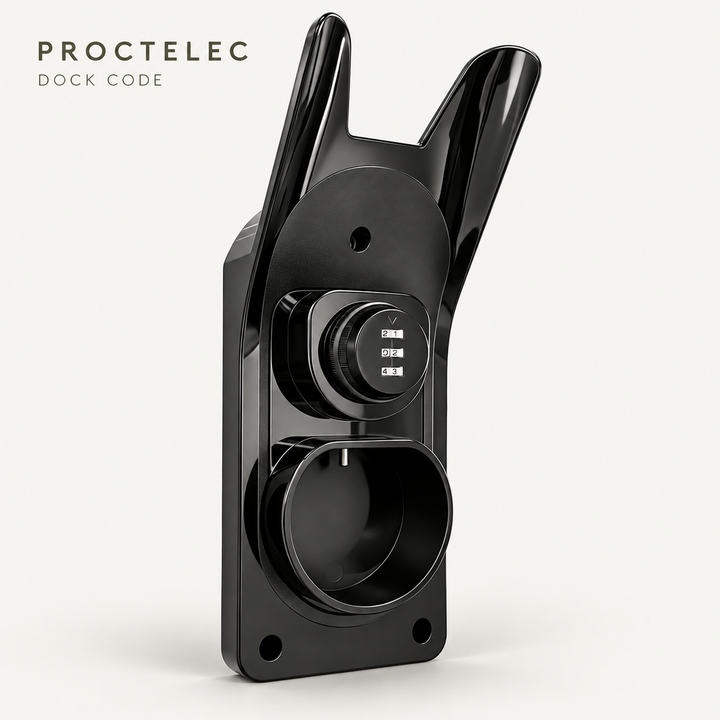
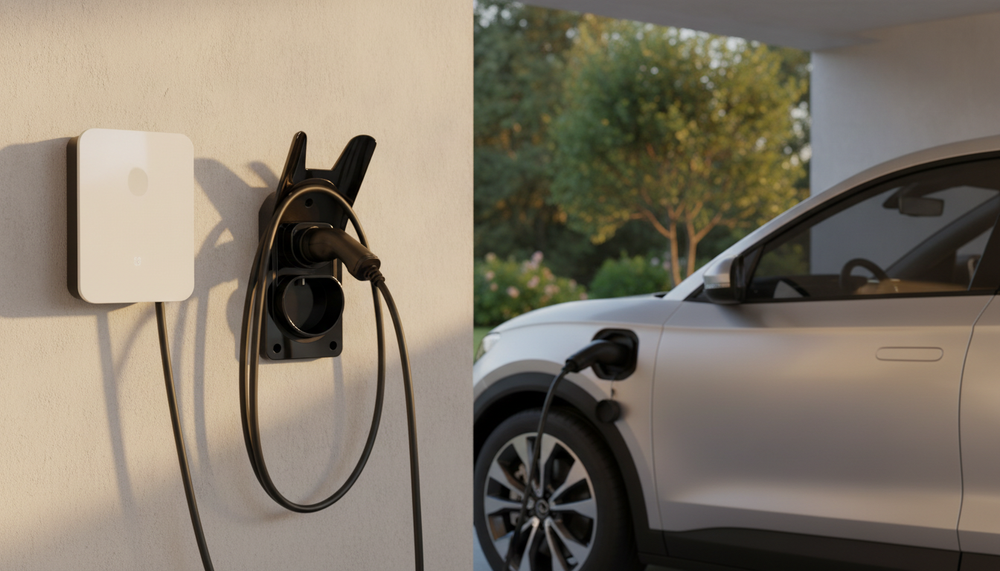
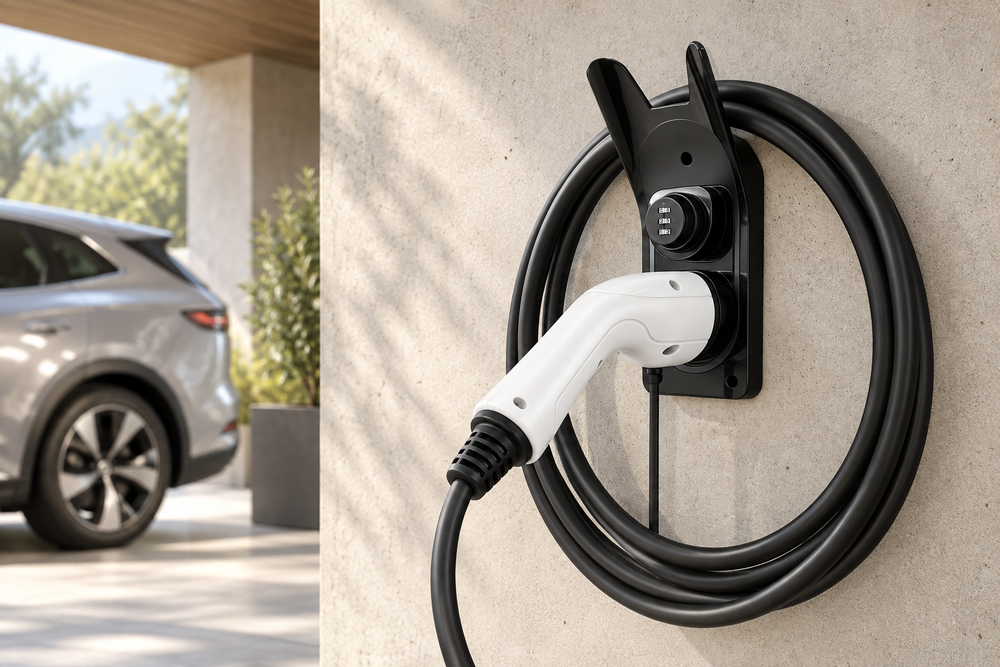
- Stored connector: the Dock Code holder (€39.90) retains the Type 2 connector when not in use with a 3-digit code. It does not work during charging or against the cable being cut.
- Parking space: the Park parking barrier (€129.90) reserves a private space. It is not an anti-collision barrier.
- Cable exposed to cutting: the EV Cable Shield kit by CatStrap (AC 3 m, €499) addresses this specific risk.
An accessory fitted near the charger must never cover the controls, obstruct ventilation or require drilling near the electrical inputs.
Apartment buildings, businesses, car parks: a multi-point project
On a site with several chargers, each point keeps its own circuit and RCD, and an energy management system generally shares out the available power. Physical protection is best standardised from the design stage: the same cable holders, the same enclosure approach, clear marking of the bays. Describe your project to our professional team to receive a proposal tailored to the number of charging points.
EV charger electrical protection: frequently asked questions
Which RCD for a 7.4 kW wallbox?
A 30 mA RCD dedicated to the charger: type A or F if the wallbox has built-in 6 mA DC leakage detection, type B otherwise. Check your model’s manual and have the choice approved by your electrician.
Is a type AC RCD enough for an EV charger?
No. Type AC only detects sinusoidal AC faults and is not suitable for an electric vehicle charging point.
Is a surge protector mandatory for an EV charger?
Not always. In France, it may be required depending on the configuration, particularly with a lightning rod, an overhead supply in a thunderstorm-prone area or a publicly accessible charging point. Your electrician determines whether it is needed.
Can I install my EV charger myself?
In France, not above 3.7 kW: the installation must be carried out by an IRVE-qualified professional. Below that, the work must comply with NF C 15-100 and remains a job for a competent electrician. In other countries, follow local regulations and use a qualified electrician.
Can Proctelec supply or install the RCD?
No. Proctelec only offers physical protection accessories: shelters, cable storage, anti-theft devices, parking barrier. Electrical equipment and its installation are the responsibility of your qualified EV-charging electrician.
Complete electrical safety with physical protection
Has your electrical installation been approved? Now protect the charger housing, the cable and the charging bay with accessories suited to your set-up.
See the complete protection guide →
Several charging points to equip? Request a professional quote.