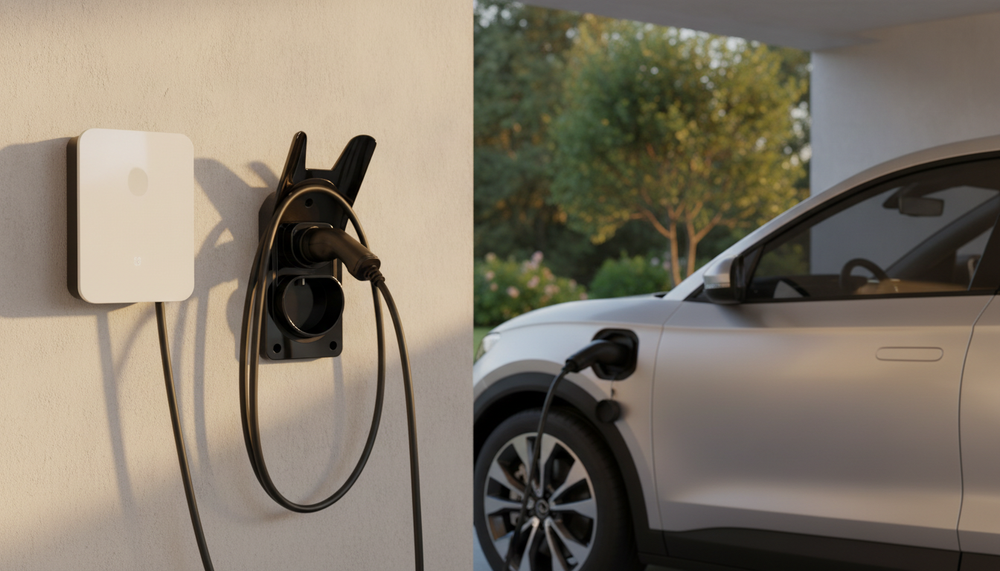
An outdoor EV charger faces rain, sun, frost, wind and sometimes light-fingered passers-by every year. If it is designed and installed for outdoor use, it is built for this. Even so, a few good habits and well-chosen accessories reduce wear and unpleasant surprises. Here is how to protect an outdoor EV charger season by season without interfering with how it works.
- First check that the charger is designed for outdoor use: the IP rating, IK rating and temperature range in its manual.
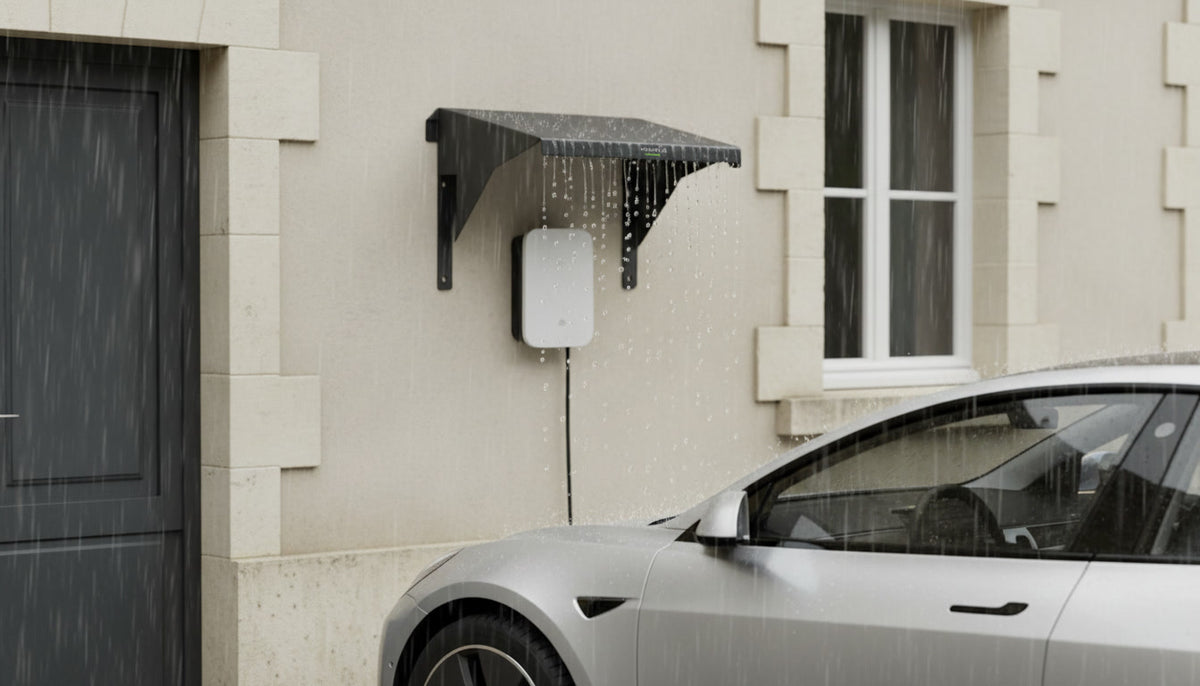
- Rain and snow: a canopy limits direct exposure without changing the IP rating.
- Sun: shade yes, a closed, poorly ventilated enclosure no.
- Frost: never force a connector or charging flap that is frozen.
- Theft and impacts: deal with them separately, with dedicated solutions.
An outdoor EV charger must first be designed for outdoor use
No accessory can turn an indoor charger into an outdoor one. Start with the manual: it gives the protection rating against water and dust (IP), the impact resistance (IK) and the operating temperature range. Installation rules set minimum levels depending on the location. In practice, an IP54 rating is commonly recommended outdoors, IP55 to IP65 for a very exposed location, and IK08 to IK10 ratings in open car parks.
The location is decided with a qualified EV-charging electrician (IRVE-certified in France), at the same time as the electrical protection. Our article on EV charger electrical protection covers that side in detail. The advice below concerns physical protection, once the charger has been correctly installed.
EV charger in the rain: limiting direct exposure
Can you charge in the rain? Yes, with a charger and charging cable designed for outdoor use, in good condition and used according to their manuals. Connectors are designed for this kind of use. However, never charge with equipment that is cracked, crushed or has a damaged component.
What rain mostly wears down is the charger’s surroundings: water running down the wall, an overflowing gutter, a connector left on the ground in a puddle, mud splashed onto the handle. Three simple habits help:
- Cover the top of the housing. The Shelter canopy (€44.90) limits direct rain and deposits on a wall-mounted wallbox, while leaving the socket accessible during charging.
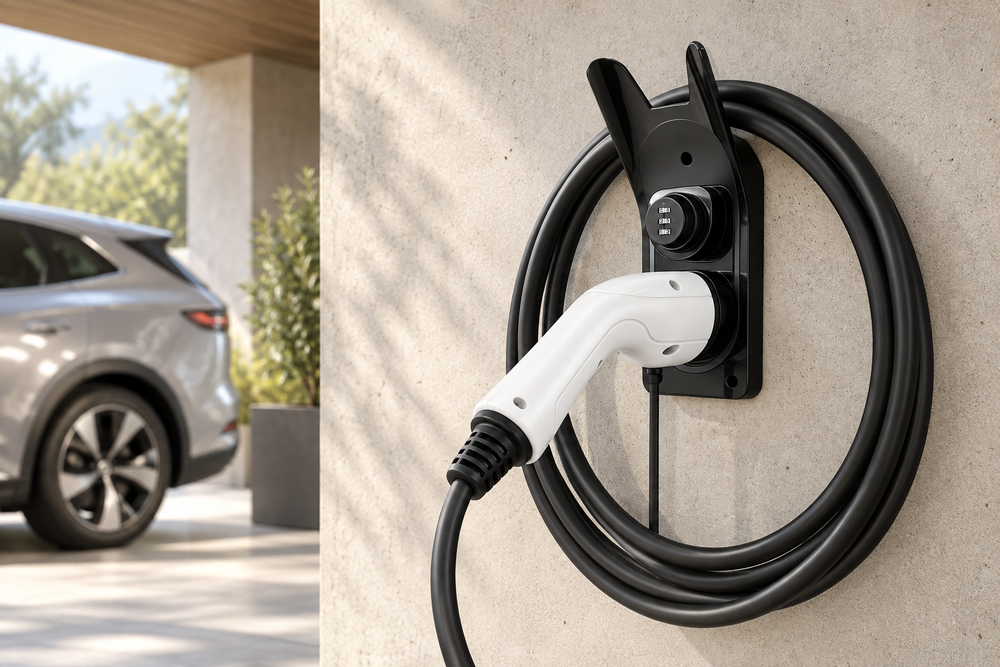
- Never leave the connector on the ground. A wall holder such as the Dock T2 (€24.90) gives it a place away from puddles.
- Think about the vehicle’s charging flap. A charger shelter does not cover it; the Port charging port cover (€34.90) is designed for this area.
A shelter does not make the charger watertight. Water ingress or visible condensation inside the housing calls for a diagnosis, not an extra roof.
EV charger in the sun: heat and UV
A charger’s electronics heat up during charging. In high summer, on a wall facing due south or due west, the housing temperature can rise sharply. Some chargers then reduce their power to protect themselves: charging slows down without anything being broken. Check the operating temperature range given by the manufacturer.
Ultraviolet light, meanwhile, ages plastics, seals, the display and the cable sheath. A cable left lying on a scorching driveway wears faster than one stored on the wall.
- Provide shade without enclosing. A canopy shades the top of the housing. Do not enclose the charger in a closed space whose ventilation has not been approved.
- Store the cable after each charge. The Loop T2 holder (€34.90) keeps the cable and connector on the wall, off the hot ground.
- Never charge under a cover, unless the manufacturer has given written approval: it is designed for when the charger is not in use.
Frost and snow: three key habits
Cold makes the cable stiff: store it in loose loops, without bending it against a corner. If the connector is stuck because of frost, do not pull hard and never pour hot water on it: follow the vehicle manual. Remove snow from the charger with a soft brush, without metal tools; a Shelter canopy limits build-up on an exposed wall, and a Cover storage cover protects a charger left unused all winter (remove it before charging).
Clearing snow, a frozen connector, slower charging, an RCD that trips during the thaw: every step is detailed in our guide EV charger in winter: snow, ice and cold.
Wind, dust, pollen and salty air
Wind blows leaves, dust and pollen right into the connector housing. A connector stored in its holder stays cleaner than one that hangs down or lies on the ground. For a J1772 connector, the Dock J holder (€39.90) does the same job. A cover used while the charger is idle must be held securely: check that it stays in place in very windy locations.
By the sea, salty air speeds up corrosion. Clean the charger and connector according to the manufacturer’s instructions, without a pressure washer, and report any sign of oxidation to your electrician.
Theft and vandalism: the other outdoor risk
Outdoors, the charger is also more accessible. Depending on the location, the risk concerns the connector left in place, the cable being cut or the housing itself. No solution guarantees that nothing will be stolen, but each one makes an opportunistic attempt harder:
- Stored Type 2 connector: the Dock Code (€39.90) holds it when not in use with a 3-digit code. It does not lock the plug during charging and does not prevent cutting.
- Access to the housing: the steel Vault enclosure, with a transparent door and a combination lock, comes in two sizes, from €199.90. Ventilation and clearances must be approved with your electrician.
- Cable exposed to cutting: the EV Cable Shield kit by CatStrap (AC 3 m, €499).
- Accessories and adapters: the Tether accessory security cable (€29.90) and the Lock J (€24.90) for J1772 adapters.
To find out more, read our guides on charging cable theft, EV charger anti-theft protection and vandalism in car parks.
Impacts, manoeuvres and cables on the ground
A charger installed at the edge of a driveway or at the end of a parking space is exposed to bumpers. The best protection is still the location, chosen with the electrician. If there is a real risk of impact, have specific mechanical protection assessed, such as a wheel stop or a barrier fixed to the ground. The Park parking barrier (€129.90) is for reserving a private space: it is not an anti-collision barrier.
When the cable crosses a walkway during charging, the three-channel Pass cable protector (€109.90) helps route it and make the obstacle visible. Check the channel diameter and intended use on the product page. See also our guide to parking barriers for EV charging spaces.
Summary: which risk, which protection?
| Risk | Solution to consider | Limitation to know |
|---|---|---|
| Rain and snow on the housing | Shelter canopy | Does not change the charger’s IP rating. |
| Sun and heat | Shaded location, canopy, cable stored on the wall | Never enclose the charger without approved ventilation. |
| Charger unused in winter | Cover or Cover Post | Remove before each charge. |
| Dirty connector or connector on the ground | Dock T2, Dock J | Check the shape of the handle. |
| Removal of the stored connector | Dock Code | When not in use only; not against cutting. |
| Access to the housing | Vault enclosure | Ventilation and clearances to be approved; not tamper-proof. |
| Cut cable | EV Cable Shield | AC 3 m kit; check compatibility. |
| Space taken | Park parking barrier | Space reservation, not anti-collision protection. |
A five-minute seasonal routine
- Spring: remove pollen and dust from the connector as described in the manual, check the canopy’s fixings.
- Summer: store the cable in the shade after each charge, watch for slower charging during the hottest hours.
- Autumn: clear away leaves, check the gutter above the charger.
- Winter: clear snow with a soft brush, cover an unused charger, never force a frozen connector.
- All year round: visually inspect the cable. At the slightest sign of damage, follow our guide damaged or cut EV charging cable.
Outdoor EV charger: frequently asked questions
Can you install an EV charger outdoors without a shelter?
Yes, if the charger is designed for outdoor use and installed according to its manual. A shelter becomes useful to limit direct exposure on a very exposed wall or to cover a charger that is not in use.
Is it dangerous to charge in the rain?
With a charger and cable designed for outdoor use, in good condition and used according to their manuals, charging in the rain is an intended use. Never charge with damaged equipment.
Does heat damage an EV charger?
Prolonged exposure to the sun ages plastics and can cause some chargers to reduce their power. A shaded location or a canopy helps, provided the ventilation specified by the manufacturer is respected.
What should I do if the connector is frozen in the socket?
Do not force it and do not use hot water. Follow the vehicle manufacturer’s instructions, which may include a de-icing or preconditioning function. The other winter tips are gathered in our guide to EV chargers in winter.
Does an outdoor wallbox shelter protect against theft?
A canopy or cover does not. To limit access to the housing, consider a lockable enclosure such as Vault; for the stored connector, a combination-lock holder such as Dock Code. No accessory makes a charger tamper-proof.
Find the right shelter for your outdoor EV charger
Canopy, cover or enclosure: compare the solutions according to your charger, wall-mounted or on a post, and its exposure. Free standard shipping in France from €65.
Unsure about compatibility? Send us the model reference and a photo of your charger.